

EQUIPMENT KNOWLEDGE / SELECTION
Cement Feeder: Selection Analysis of Spiral, Belt, Volumetric and Weight Feeding
Compare conveying mechanisms and measurement methods when selecting equipment for cement powder, aggregates and controlled feeding.
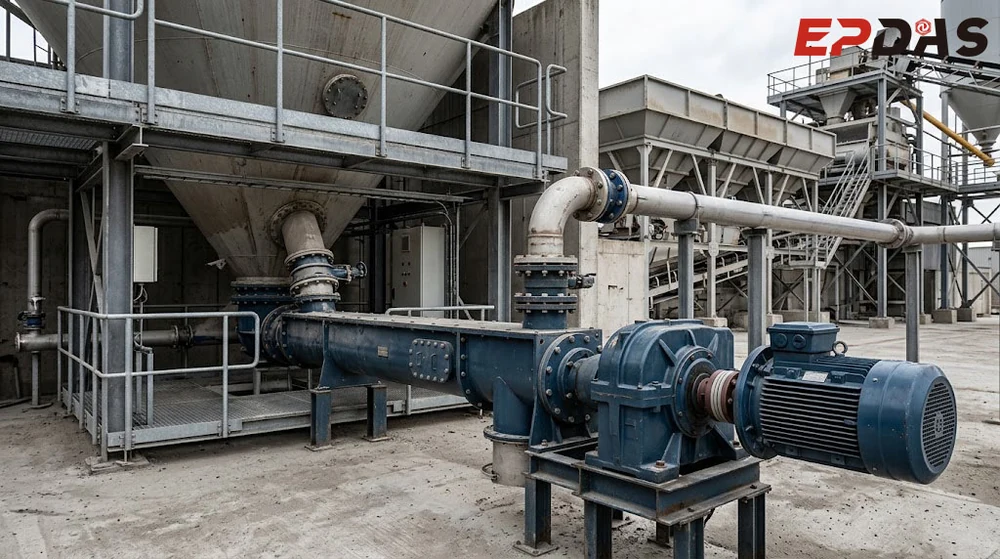
Cement is an extremely fine and easy-to-fly dry powder bulk material. In the silo discharge, concrete mixing station ingredients and special dry powder mortar production, the choice of feeding equipment directly determines the stability of the ingredients and the quality of the final product. In the actual project selection, on-site personnel often confuse spiral feeders and belt feeders with volumetric feeders and weight feeders. In fact, this is the definition of the feeding system from two completely different dimensions:
Conveying actuator (hardware structure): to solve the problem of "how the material is physically displaced", the representative equipment is a screw feeder and a belt feeder;
Measurement and detection method (control logic): Solve the problem of "how to count and control the output", which is divided into volumetric feeding and weight feeding.
Conveying Actuator: Spiral and Belt
Spiral feeder
The core of the spiral feeder is composed of a tubular or grooved shell and internal rotating spiral blades. The motor drives the spiral shaft to rotate continuously, and the powder moves along the axis through the blade thrust to achieve closed continuous conveying.
Material adaptation: This structure is extremely suitable for cement and other dry fine powders. The extremely fine particle size is not easy to cause mechanical jamming, and the fully closed shell can perfectly curb dust flying, which is the first choice for unloading in the lower part of the cement silo.
Factors affecting the flow rate: The actual feeding volume is not only determined by the spiral speed. The accumulation density and changes in the flow state of cement will significantly interfere with the output efficiency. If the cement is damp and clumped or "bridged" occurs at the mouth of the warehouse, even if the spiral maintains a constant speed, the actual output will drop sharply. In addition, the long-term hanging wall clumping of the blade and the inner wall will compress the effective volume, resulting in feed attenuation.
Typical application: the pre-material section before unloading in the cement silo and the powder metering of the mixing station.
Belt feeder
The belt feeder relies on the continuous cyclic load-bearing tape to support and handle the material, and controls the discharge rate by adjusting the belt running speed or the thickness of the material layer.
Material adaptation: This equipment is more suitable for block or granular bulk materials (such as sand and aggregates) with uniform particles. This kind of material can form a stable stacking angle on the surface of the belt, which is not easy to leak and fly.
Factors affecting the flow rate: the uniformity of the cross-sectional distribution of the material on the belt and the fluctuation of the thickness of the material layer will directly change the amount of material output per unit time.
Limitations: At the project site, the belt feeder is rarely directly used for cement powder conveying. The cement particles are extremely fine, and it is difficult for ordinary belt edges to achieve absolute sealing. It is easy to cause violent dust during operation, and fine powder is easy to leak through the cracks, causing serious material loss and on-site environmental pollution.
Measurement and Testing Methods: Volumetric and Weight
Volumetric feeding
The core logic of volumetric feeding is to control the volume of equipment output materials per unit time (for example, by controlling the spiral speed or the opening of the discharge valve).
Limitations: The system cannot sense the change of material stacking density. Because cement is susceptible to the influence of gas content, static time and warehouse pressure, the accumulation density fluctuates violently; once the density changes, even if the output volume is constant, the actual mass flow rate of the feed will also have serious deviations.
Advantages: simple mechanical structure, low investment and maintenance costs.
Weight feeding
The weight feeding directly takes the material quality as the control benchmark, and introduces the weighing module to collect real-time data to form a closed-loop control.
Common forms: weightless feeder (monitoring the deceleration rate of the entire hopper and feeder weight over time) and weighing belt feeder (real-time weighing of materials that pass dynamically on the belt).
Advantages and requirements: It can automatically offset most of the errors caused by changes in material stacking density. However, its accuracy is highly dependent on the reliability of the weighing sensor, the on-site vibration resistance and regular calibration.
Applicable scenarios: high-performance concrete, special dry powder mortar and other precise control conditions with extremely low fault tolerance rate for powder ratio.
Selection Consideration and Combination Application
When selecting the model, it is necessary to first select the mechanical structure according to the physical characteristics of the material, and then match the measurement logic according to the process accuracy requirements:
On small screens, swipe the table horizontally to compare all columns.
| Feeding equipment / method | Typical application scenarios | Core considerations of selection |
|---|---|---|
| Screw feeder | Cement, fly ash and other fine dry powders | Fluidity (anti-bridge/stroke), spiral speed range, wall-hanging material accumulation problems |
| Belt feeder | Granular bulk materials such as sand and stone, aggregates, etc. | Belt sealing, material layer thickness control, material distribution uniformity |
| Volumetric feeding | Rough batching, auxiliary material addition | Stability requirements of material stacking density |
| Weight feeding | High-precision continuous batching system | Weighing sensor accuracy, on-site earthquake resistance, regular calibration conditions |
In actual engineering, the screw conveyor is often installed under the independently suspended weighing hopper, forming a "weightless screw feeding system". At this time, the hardware conveying is still a wear-resistant sealed spiral mechanism, but the control logic is switched to closed-loop weight measurement. This strong combination not only solves the problem of sealed conveying of cement powder, but also meets the requirements of high-precision quality ingredients.
Conclusion
The conveying mechanism determines how the material is physically pushed, and the measurement method determines how the system accurately controls the discharge. There is no universal feeding equipment in the industrial site. The best selection scheme must comprehensively evaluate the fluid characteristics, process allowable error, on-site vibration environment and post-maintenance ability of cement powder, and find the best solution between mechanical structure and measurement logic.
The comparison table and complete supplied reading structure are retained. No model-specific accuracy guarantee or service promise is added.
Put the article into practice
Review the equipment range and request the configuration-specific information for your operation.
Discuss your equipment requirements
Share the application, materials, load or output, operating environment and destination.
Ask about your equipment